Numbers tell you what a player has done. They do not tell you why, and they do not tell you whether it travels. A player who dominates one league can disappear in another, and a statistical profile rarely warns you in advance.
My process is built to close that gap. It combines statistical analysis, structured match observation, and a reading of the player’s psychology. Each layer checks the others. The result is a rating you can compare across leagues and a profile you can coach from, not a hunch dressed up as a verdict.
Here is how I work:

I start with the trajectory
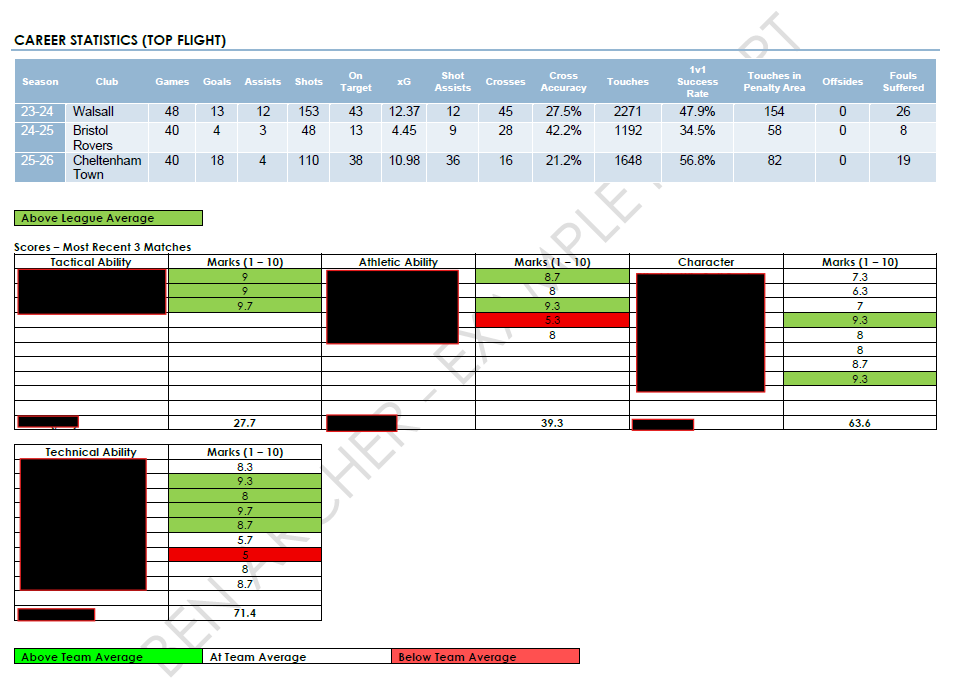
Every assessment begins with data drawn from reputable sources. I map where a player has been and the direction they are moving. This sets a baseline and answers a question clubs often miss. Is recent form a genuine step up, a plateau, or the early signs of a decline.
The trajectory tells me what to look for before I watch a single minute. It frames the rest of the work.
I turn observation into measurement
I then watch a sample of matches, usually between two and five, depending on the brief and the player. I do not rely on impression. I count specific actions tied to the demands of the position, and I build those counts into measures of technical proficiency.
This is the discipline that separates structured scouting from opinion. Two analysts can watch the same match and remember different games. A measure built from counted actions holds up when someone asks you to justify it.
I read what the data cannot see
While I watch, I am tracking the things statistics never capture. What the player does off the ball. How they communicate with teammates. How their body language reads when the game turns against them. What role they hold within the group, and whether others look to them or around them.

This is the psychological layer, and it is often where a recruitment decision is won or lost. A technically sound player who cannot integrate is a risk. I want to know that before a club commits.
I benchmark and adjust for league
I then pull the layers together. I benchmark the player against their own team and against the opponents they faced, which controls for the standard they are competing in. From this I produce a single rating, the League-Adjusted Player Score, that is comparable across competitions.
This is the part that solves the translation problem. It lets a club weigh a standout in one division against a steady performer in another, on the same scale, without guessing.
Clubs receive two profiles
The output comes in two parts.
A summary profile gives you the quick read for an early decision. A comprehensive profile goes deeper, setting out the player’s strengths, their weaknesses, and the coaching points that would help them develop in your environment.
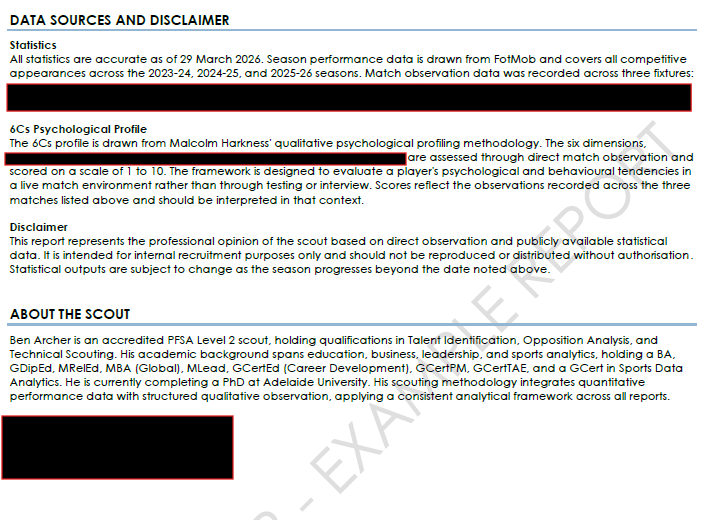
The comprehensive profile also flags the psychometric areas that influence performance and team integration. These are the factors that shape whether a player reaches their ceiling with you, and whether they fit the group you are building.




What this gives you
A recruitment decision you can defend. Every rating is traceable to counted actions and benchmarked context, and every profile tells you not just how good a player is, but whether they will be good for you.
Have a player to assess or a brief to fill? Get in touch and let’s talk.